

Data is at the core of most business operations, from customer management and accounting to manufacturing, logistics, and internal workflows. Losing access to critical data can bring a company to a standstill even when the rest of its IT infrastructure is still running.
That is why backups should not be treated as an emergency measure. They should be a permanent part of an organization’s cybersecurity and business continuity strategy.
Why backups are essential
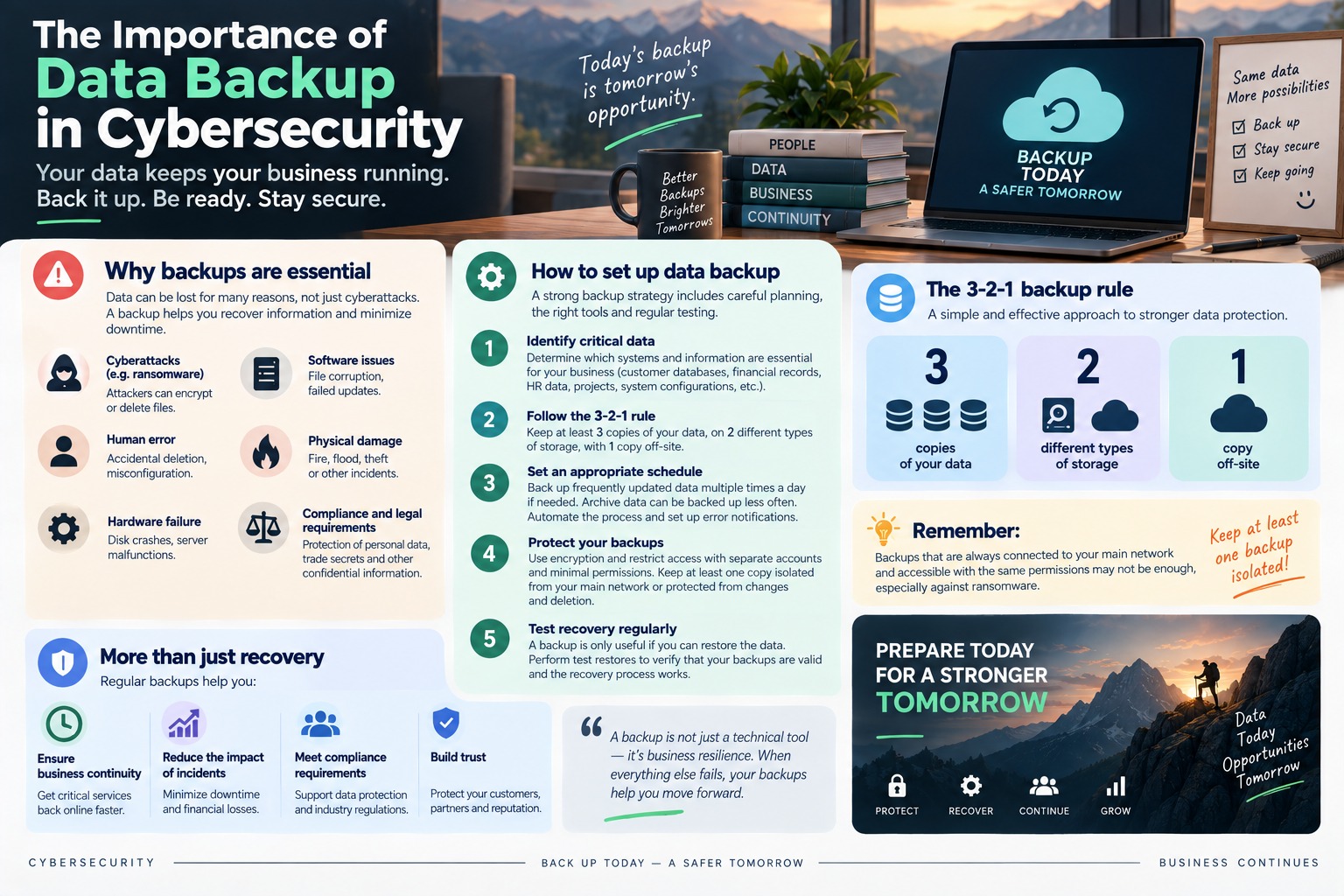
Cyberattacks are only one of the many ways businesses can lose data. Human error, hardware failure, corrupted files, software bugs, failed updates, and physical damage to equipment can all result in data loss.
Having a recent backup makes it possible to restore important information and reduce downtime.
Backups are especially important when dealing with ransomware. Attackers often try to do more than encrypt production data: they may also search for and delete accessible backups to make recovery more difficult and increase pressure on the victim.
For this reason, backups that are permanently connected to the main network and accessible through the same user accounts or permissions should not be considered sufficient protection.
Backups also play a key role in business continuity. The more an organization depends on digital systems, the greater the impact of an outage. A well-defined recovery process can help restore critical applications, databases, and documents much faster after an incident.
Data protection and retention are also important from a compliance perspective. Organizations may need to protect personal data, intellectual property, financial records, and other sensitive or confidential information in line with applicable laws, regulations, contracts, and internal policies.
Simply creating backups is not enough. Access, retention periods, encryption, and secure deletion all need to be managed properly.
How to build an effective backup strategy
The first step is identifying which systems and data are critical to the business. This typically includes customer databases, financial records, employee information, active projects, server configurations, and critical business applications.
For each system, organizations should determine how much data they can afford to lose and how quickly operations need to be restored. These requirements are commonly defined through a Recovery Point Objective (RPO) and a Recovery Time Objective (RTO).
The 3-2-1 backup rule remains a practical starting point: keep at least three copies of your data, store them on two different types of storage, and keep at least one copy off-site.
For stronger protection against ransomware, at least one backup should also be isolated from the production environment or made immutable so that it cannot be easily modified or deleted.
Backup frequency should reflect how often the underlying data changes. Critical databases may need to be backed up several times a day — or even more frequently — while long-term archives may require much less frequent backups.

Whenever possible, the process should be automated, with monitoring and alerts in place for failed or incomplete backup jobs.
Backups should also be encrypted, and access should be restricted using dedicated accounts and the principle of least privilege. Backup storage should not be broadly accessible from the production network.
Just as importantly, organizations need to test their backups regularly.
A successful backup job does not automatically mean the data can actually be restored. Recovery testing can uncover corrupted backup files, configuration issues, missing dependencies, and recovery processes that take much longer than expected.
Backups are not a replacement for endpoint security, multi-factor authentication, regular patching, network segmentation, or strong access controls. Their purpose is different: they provide a reliable way to recover when prevention fails.
Effective cybersecurity relies on multiple layers of protection. Backups are one of the most important of those layers — and often the last line of defense when an incident cannot be prevented.