

Digital tools have changed the way recruitment works. Manual resume screening, long email exchanges, and mandatory in-person meetings are increasingly being replaced by faster and more flexible processes. HR teams now use a wide range of recruitment technologies, including candidate screening tools, applicant tracking systems, and communication platforms. These solutions help reduce repetitive work, process applications faster, and keep candidate information in one place.
Technologies for sourcing and hiring
Several technologies are now widely used across modern recruitment teams.
Recruitment automation
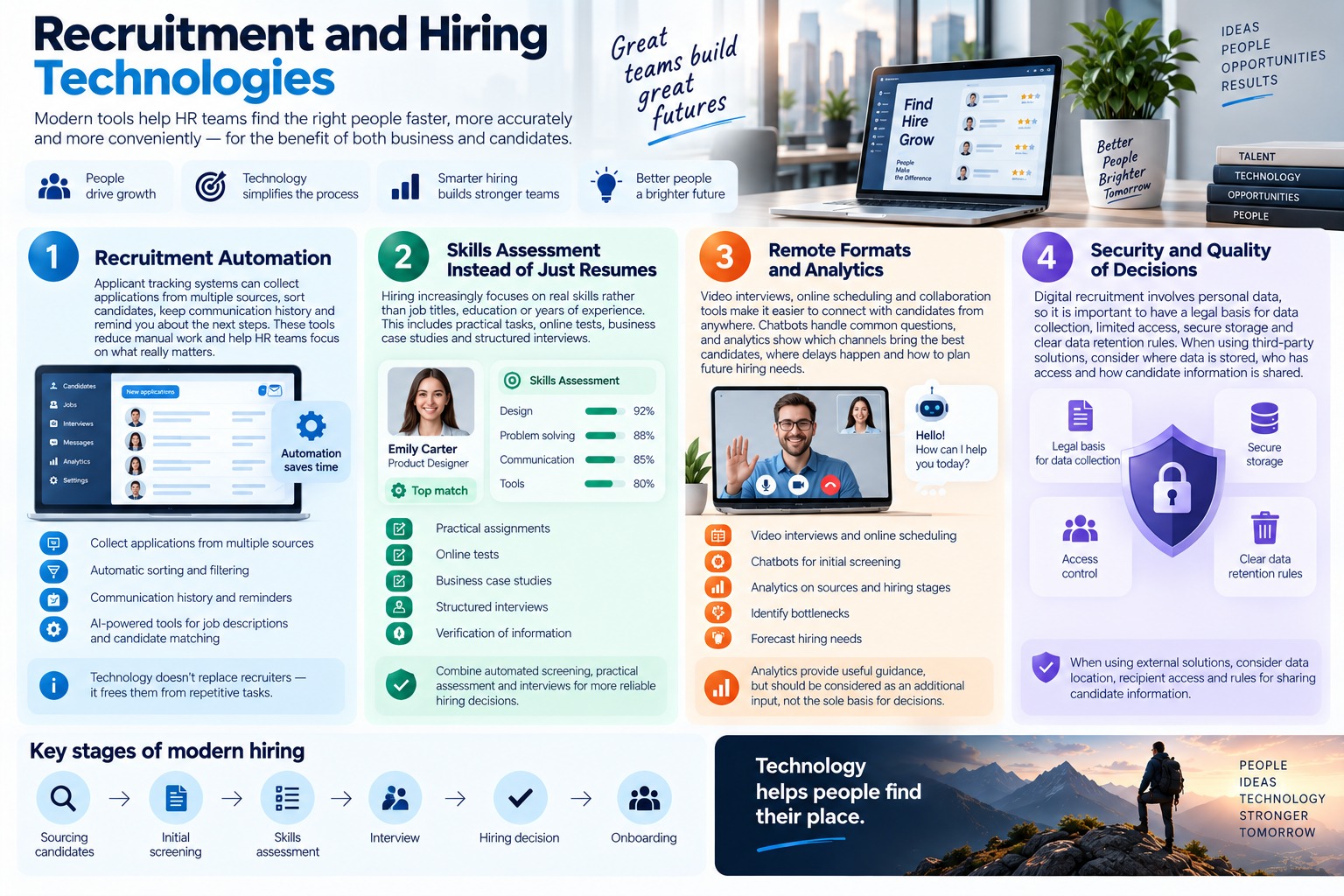
Recruitment systems can collect applications from multiple sources, sort candidates based on predefined criteria, store communication history, and send reminders about upcoming stages.
Depending on business needs, recruitment and hiring technologies may include applicant tracking systems, candidate relationship management tools, screening platforms, and automated communication software. The main value of these tools is not replacing recruiters. Instead, they reduce the amount of repetitive administrative work involved in the hiring process.
Artificial intelligence has also become a growing part of recruitment technology. AI tools can help create job description drafts, identify matches between job requirements and resumes, generate interview questions, and process large volumes of candidate information.
Automated assessments, however, work best as one source of information rather than a final decision. Results can depend on the criteria used, the quality of the underlying data, and how closely a candidate’s experience fits the patterns recognized by the system.
Skills-based hiring instead of resume-first screening
Skills-based hiring has become more common as employers place greater emphasis on practical ability rather than job titles, education, or years of experience alone.
Common assessment methods include practical assignments, online skills tests, job simulations, and structured interviews. This approach can be especially useful in fast-changing fields where required skills evolve faster than traditional job descriptions.
Verifying candidate information has also become more important. Generative AI can quickly produce polished resumes, cover letters, and answers to standard assessment questions. As a result, a resume alone may provide less evidence of actual ability than it once did. A stronger hiring process combines automated sourcing with practical assessments, qualification checks, and meaningful interviews.

Remote hiring and recruitment analytics
Video interviews make it easier for employers and candidates in different locations to connect. Scheduling tools, digital calendars, and recruitment platforms also reduce the amount of coordination required between hiring stages. Chatbots are often used in high-volume recruitment. They can answer common questions, collect basic candidate information, provide application updates, and route relevant applications to recruiters.
Recruitment analytics can show which sourcing channels produce qualified candidates, where delays occur, how many stages candidates complete, and which parts of the process create bottlenecks. Predictive models can also support workforce planning by estimating future hiring needs. These forecasts are generally more useful as an additional planning signal than as the sole basis for staffing decisions.
Data security and decision quality
Digital recruitment involves the collection and processing of personal data, making privacy and security an important part of the hiring process.
Candidate information should be collected on an appropriate legal basis, access should be limited, data should be stored securely, and clear retention and deletion policies should be in place. When third-party recruitment tools are used, factors such as data hosting locations, access permissions, data transfers, and vendor privacy practices also require attention.
Recruitment technology tends to deliver the most value when it removes repetitive tasks without replacing professional judgment. Effective hiring still depends on clear job requirements, reliable skills assessment, responsible data handling, and transparent communication throughout the recruitment process.