

Artificial intelligence is rapidly moving beyond research labs. AI systems now help write software, analyze medical images, forecast weather, manage industrial processes, discover new materials, and process large amounts of data.
In practice, AI development is moving in several directions at once. Models are becoming more capable, while AI features are being built into everyday software, business tools, and workflows. This shift from isolated experiments to practical use has become one of the most important technology trends of recent years.
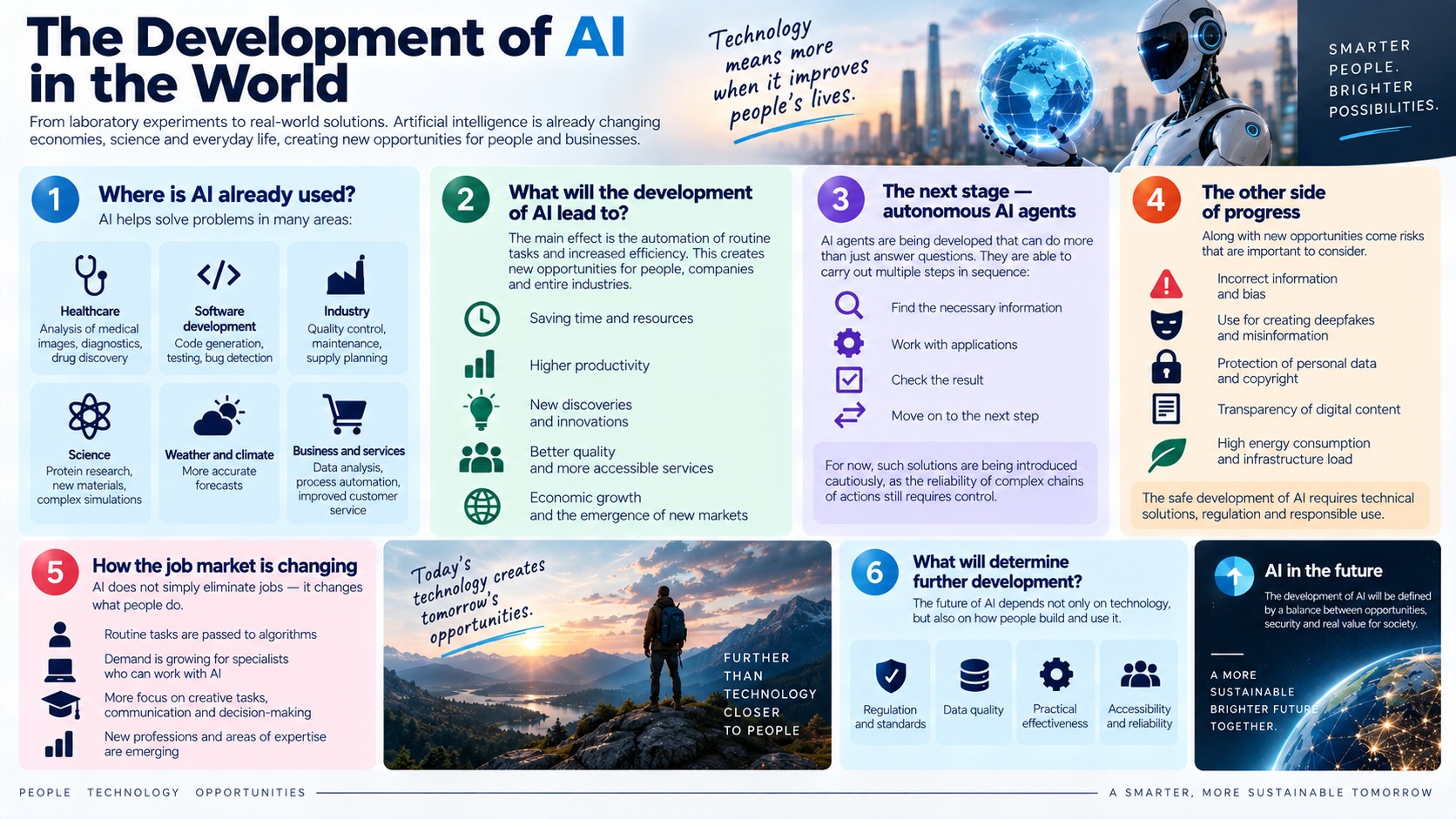
Where AI development is leading
One of the most visible effects of AI is the automation of repetitive tasks. AI systems can prepare drafts, find information, sort documents, handle basic customer requests, and perform initial data analysis.
In manufacturing, machine learning supports quality control, equipment maintenance, and supply planning. In software development, AI assistants can help identify bugs, generate tests, and produce sections of code.
Science is also changing. Computational models can support research into protein structures, promising molecules, new materials, and complex physical systems. Weather forecasting is another growing area. AI-based methods can work alongside traditional forecasting models and process large volumes of observations at much higher speeds.
The next stage: autonomous assistants
Digital agents are becoming an important area of AI development. A standard chatbot usually responds to a single request. An AI agent can go further by completing a sequence of actions.
Such systems can search for information, work with applications, check results, and continue to the next step of a task. Adoption remains cautious because long chains of automated actions can still produce errors and require monitoring.
At the same time, smaller and more efficient AI models are gaining attention. Developers are working to reduce computing costs, improve response times, and run AI features directly on computers, smartphones, and other devices.
Local processing can reduce reliance on cloud infrastructure and may also improve privacy by keeping more data on the device.
The other side of progress
Rapid AI adoption also creates new risks. Generative systems can produce inaccurate information, reproduce bias found in training data, or create convincing fake content.
As a result, discussions around AI increasingly focus not only on model capabilities but also on the conditions in which these systems are used. Major issues include personal data protection, copyright, transparency around AI-generated content, and the broader question of safe AI development.
Another challenge is resource consumption. The expansion of large data centers increases demand for electricity, cooling systems, advanced chips, and other infrastructure.
The technology industry is responding in several ways. More efficient processors are being developed, software is becoming less computationally intensive, and data center designs are being optimized to reduce energy use.
How the labor market is changing
Automation does not simply mean that entire professions disappear. In many cases, the nature of a job changes instead.
Routine tasks can be handled by software, while more complex work still depends on problem definition, quality control, communication, accountability, and decisions that require context or judgment.

Demand is also growing for professionals who can use AI tools effectively and evaluate the quality of AI-generated results. In many fields, AI skills are becoming part of existing roles rather than creating completely separate occupations.
What will shape future development
One of the main challenges is balancing rapid adoption with safety and reliability. Governments are developing different regulatory approaches, while companies are strengthening data controls and researchers are improving methods for testing and evaluating AI systems.
Competition in AI is also becoming less focused on model size alone. Practical performance, cost, accessibility, reliability, and the ability to solve specific problems are becoming more important.
Artificial intelligence is already a significant part of global digital infrastructure. For that reason, the future development of AI can be viewed through several connected areas: quality of implementation, efficient use of computing resources, system reliability, and practical value across business, education, science, healthcare, and everyday life.
The direction of future progress will depend not only on what AI systems can do, but also on how effectively, safely, and responsibly the technology is deployed.